Who’s Sucking Whose Blood?
Puddock Hill Journal #115: A bat in the house.

A week ago, Pam and I awoke to a strange tapping and scratching sound in the bedroom. I turned on a light and looked around from bed. The sound stopped.
It had originated across the room. I wondered whether it came from mice in the attic, but it’s the wrong season for that. I wondered whether it was a bird tapping on the window, as cardinals and robins sometimes do, but it was still fully dark outside and they should be asleep.
A few minutes after I turned out the light, the sound resumed. I rose from bed and used the flashlight on my phone to look around. That’s when I saw it. There was a bat flattened against the bottom of an old papier-mâché wastebasket. Thinking fast, I threw a towel over the basket and shuddered.
We have a visceral fear of bats.
In the Stone Age, we likely competed with them for space in caves—where, by the way, bedbugs that preyed on bats adapted to suck blood from humans.
We process their screeches like nails on a chalkboard.
We tremble at the idea they may get tangled in human hair—an old wives’ tale with no basis in fact.
Bram Stoker brilliantly played on our prejudices when he first associated fictional vampire humans and real vampire bats. (The root of the word “vampire” is associated with witches.) And in popular imagination, the canard stuck.
But of course bats have a critical role to play in nature. Fruit-eating bats pollinate plants and disperse seeds. Insectivorous bats, such as we have in the Northeast, consume millions of flying insects, including mosquitoes and agricultural pests. Among other things, this consumption helps forests regenerate by controlling infestations.
In fact, I’d been having a pleasant dream shortly before encountering the bat. Our family of three was out on a nature excursion along a river. An unusual bird came flying towards us, and we admired it.
Awake, I couldn’t help wondering whether the bat had been flying around the room as I slept, and I processed this with my subconscious mind, working it into the dream.
We have had bats in our houses a couple times in my life, and I always opened a window and guided them out. But this bat was stuck in the wastebasket and seemed sick. Why couldn’t it escape? I immediately thought of rabies.
According to the Centers For Disease Control, only one percent of bats carry rabies, but that number rises up to six percent for bats “found grounded or acting strangely.” In unvaccinated humans, meanwhile, rabies almost always proves fatal.
I put the covered wastebasket in the garage for the night and left it there. Two days later (the county health department had been closed for Election Day), I brought the animal in for testing. The technician, taking a quick peek under the towel, thought the bat might still be alive in there. It had a reddish hue, I remembered from my brief view of the thing. Probably it was an eastern red bat, a solitary animal that sleeps in trees and migrates south for the winter.
We are told that a bat in the presence of sleeping humans might bite them or simply nick them with a tooth. Not a vampire bat (there are none in the United States)—any bat. This seems like a remote possibility, but we are told further that the bite might be indiscernible. Against this unlikely, almost fantastic scenario, we must weigh the fatality of rabies. All or nothing.
That’s what the humans were thinking. What was the bat thinking?
It may have just returned to the area after its winter in warmer climes and was looking for a comfortable place to roost. Or perhaps it just followed its curiosity around a gap in the chimney cap and found itself trapped inside our room, then attempted to seek shelter in the wastebasket. The technician said people sometimes find bats hiding in their shoes.
When we first moved to Puddock Hill, we saw bats most summer nights, flying around seeking invisible insects with their keen echolocation. Now we rarely spot them. Eight years ago, I went to the expense of putting bat houses under the eave of our barn (following expert guidance), but they never moved in. According to a piece on WHYY last year, “Pennsylvania’s bat population has suffered devastating losses because of white-nose syndrome,” an exotic fungal disease to which our native bats have little resistance. “The estimated population of the little brown bat, once the state’s most abundant bat, was between 3 and 5 million before white-nose syndrome was first identified in the state in the winter of 2008. Now, there’s about 5,000, with only 1% of the population remaining.”
While the bat in our room was not a little brown bat, I wish, after discovering the rehab facility that was the subject of the WHYY piece, that I had never taken the eastern red bat to the health department, where it was destroyed to test for rabies. Eastern red bats have not suffered from white nose syndrome, but their number are down due to habitat destruction and other human actions.
The results of the test came back negative, which doesn’t mean I wasn’t right to worry, given the binary nature of a rabies diagnosis, which equals nearly certain death.
Still, the decision gives me pause. Because it’s always this way with us humans, isn’t it? Us or them. And we always decide against them. Millions of people versus a few thousand bats. We decide against them when we cut down the forests where they dwell to build another house. We decide against them when we spray our pesticides. We decide against them when we tell creepy stories that vilify others.
I pose a simple question: Which of our species has more blood between its fangs?
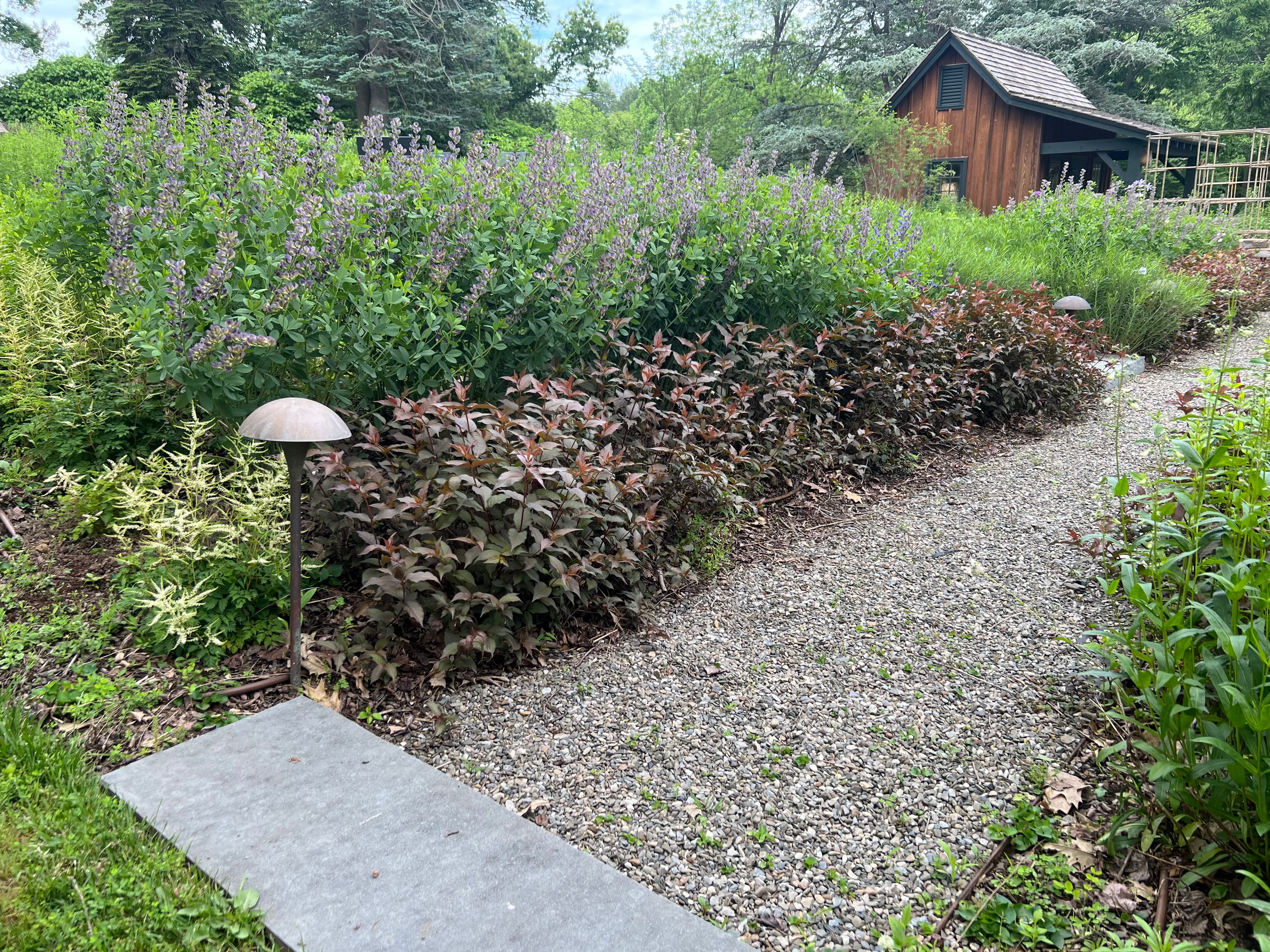
Scenes from the patio garden (mostly natives):



Very good article on bats in the house. Thank you for sharing it